-
Modern French-Chinese restaurant Mora, and two Michelin-starred TATE Dining Room to re-open

MORA (摩), the intimate 28-seater modern French Chinese restaurant founded by Vicky Lau, together with co-founder Romain Herbreteau and Head Chef Percy Ho, is now open at the historic street of Upper Lascar Row (摩羅上街), Sheung Wan, Hong Kong. This iconic location connects MORA and Hong Kong’s fascinating history with the Chinese character 摩, representing “texture”, which will be the common thread of the texture-inspired menu rooted in one of Hong Kong’s oldest culinary traditions: soy food.
MORA is now serving its CHARACTERS OF SOY soft opening tasting menu. The modern French Chinese menu is far from conventional, straying from the traditional format of appetisers, entrees and desserts, and instead separating courses by textural nuances. Every soy-based dish is served in tasteful portion sizes and with consciously selected ingredients in a bid to minimise food wastage and reduce carbon footprint as much as possible.
~~
Two-Michelin-starred TATE Dining Room presents a refined new seaweed-focused lunch menu with Chef Vicky Lau’s signature French Chinese twist, serving from Thursday – Saturday starting from now until May 2022.
Following a successful series of single-ingredient lunch menus that started from April 2020 focusing on Eggs, Rice, Tofu, Tea, Soy Sauce, Vegetables, Fruits, Mushrooms, and more, Chef-patron Vicky Lau now shines the light on Seaweed. Packed with nutrients, minerals and antioxidants, the humble seaweed’s high glutamate content is a rich source of umami flavour.
Priced at HK$1,180+10% per guest, “An Ode to Seaweed” features six courses of elevated interpretations of different variations of seaweed, bridging familiar Asian flavors with refined French techniques. Each chapter of the menu presents a new type of seaweed, from Japanese-style kombu and hijiki, to western winged kelp and dulse seaweed. While not a vegetarian menu, Ode to Seaweed does not feature any traditional meat courses, instead providing a wholesome degustation with refined creative takes on seafood and vegetables with a focus on seaweed with an objective to reduce consumption of meats.
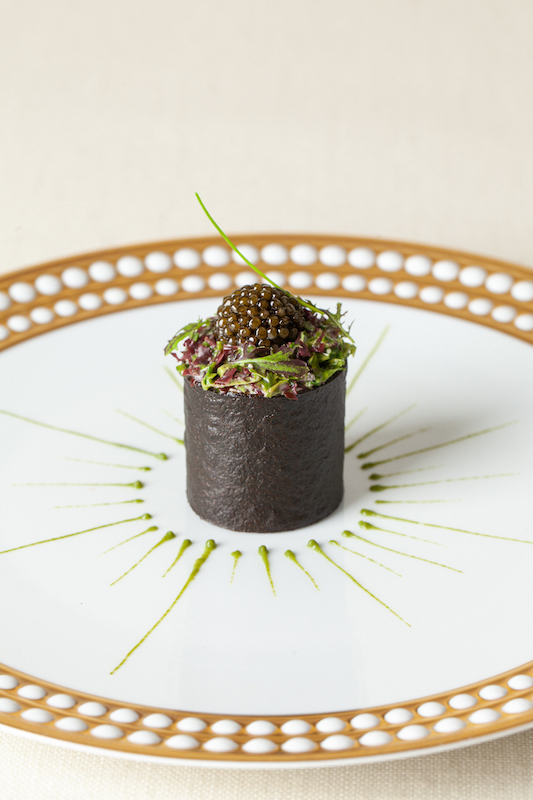
The menu begins with a selection of delicate seaweed infused amuse-bouche: seaweed sourdough cracker, sea snail with celtuce, smoked eel mousse tartlet, and squid egg custard with seaweed. The first chapter, KOMBU, features the edible kelp from the brown-algae family most famous for its use in dashi soup stock. The kombu course includes fresh local crab with ocean mousse and seaweed salad in a Japanese kombu cone, served with Jerusalem artichoke puree.
HIJIKI is an uncommon type of wild seaweed that grows on rocky coastlines and resembles dried black tea leaves, and has been part of the Japanese diet for centuries. The Hijiki course features white asparagus, local razor clam with braised Japanese hijiki seaweed, and ravioli of seaweed mousse and nuts. The dish is finished with Chinese wine and juice from the razor clams. Continue the meal with TATE’s signature freshly baked homemade brioche, this time with a new seaweed butter.
LAVER, a type of dried seaweed similarly known as nori, is a variety of red algae that grows off the coast of Japan and the British Isles. For the next course, Hokkaido scallops are cooked in seaweed butter with dried scallop sauce and laver from Chiu Chow, with the addition of Romanesco for a crunchy texture.
WINGED KELP is thought to have the highest protein content among kelps and is rich in trace metals and vitamins such as niacin. It thrives in cold waters in areas such as Scotland, Iceland and Norway, and favours the wave-exposed rocky reefs around the Irish coast. TATE presents a creative take on this special kelp, as a potato kelp millefeuille, served with langoustine and chicken jus. The millefeuille is finished with a sprinkle of sesame, seaweed and dried prawn powder.
This is followed by DULSE SEAWEED, a red algae superfood high in fiber that has been an important part of the Irish diet since the Great Famine of the 1840’s. This course uses dulse seaweed to steam threadfin fish to create an unrivalled depth of flavour, along with braised fennel, chicken, Chinese wine and aoi nori sauce. The fish is served with an umami-rich side of seaweed risotto.
The menu concludes with ARAME, another popular and versatile seaweed used in Japanese cooking. The seaweed-inspired dessert is a jasmine mousse with arame poached meringue, served with a scoop of homemade green tea ice cream.
The journey of seaweed continues into the selection of Mignadise Temptations, comprising of chocolate seaweed tuille and green tea chocolate rocher.